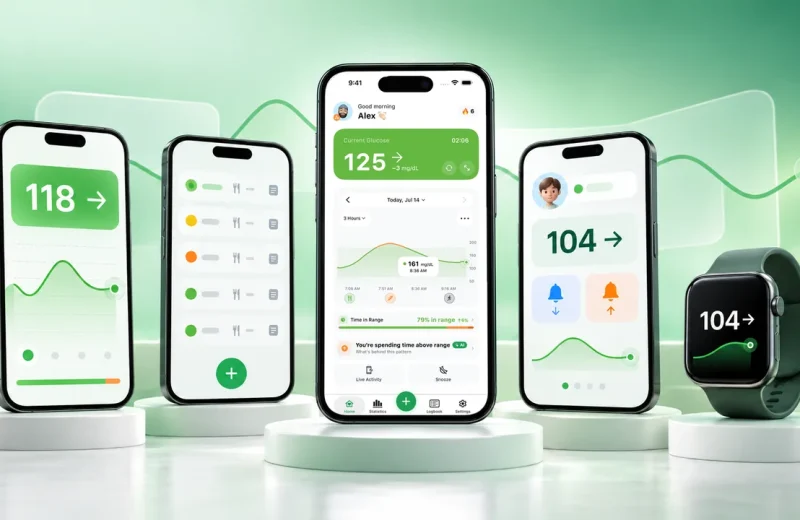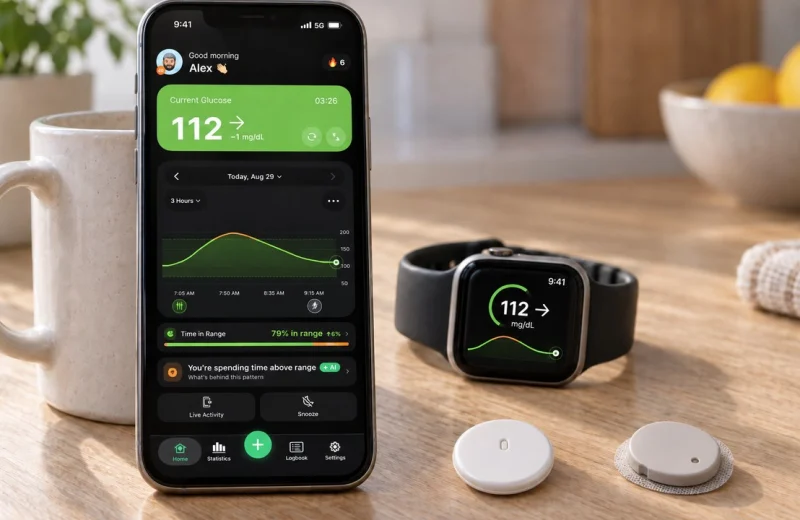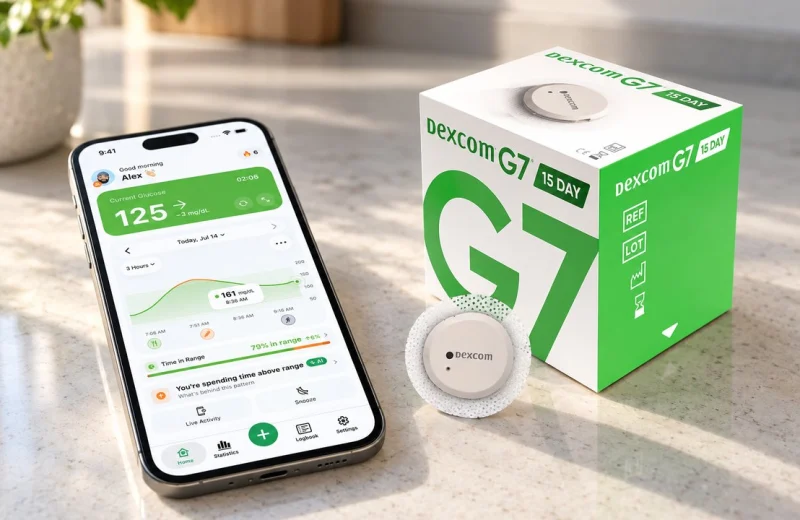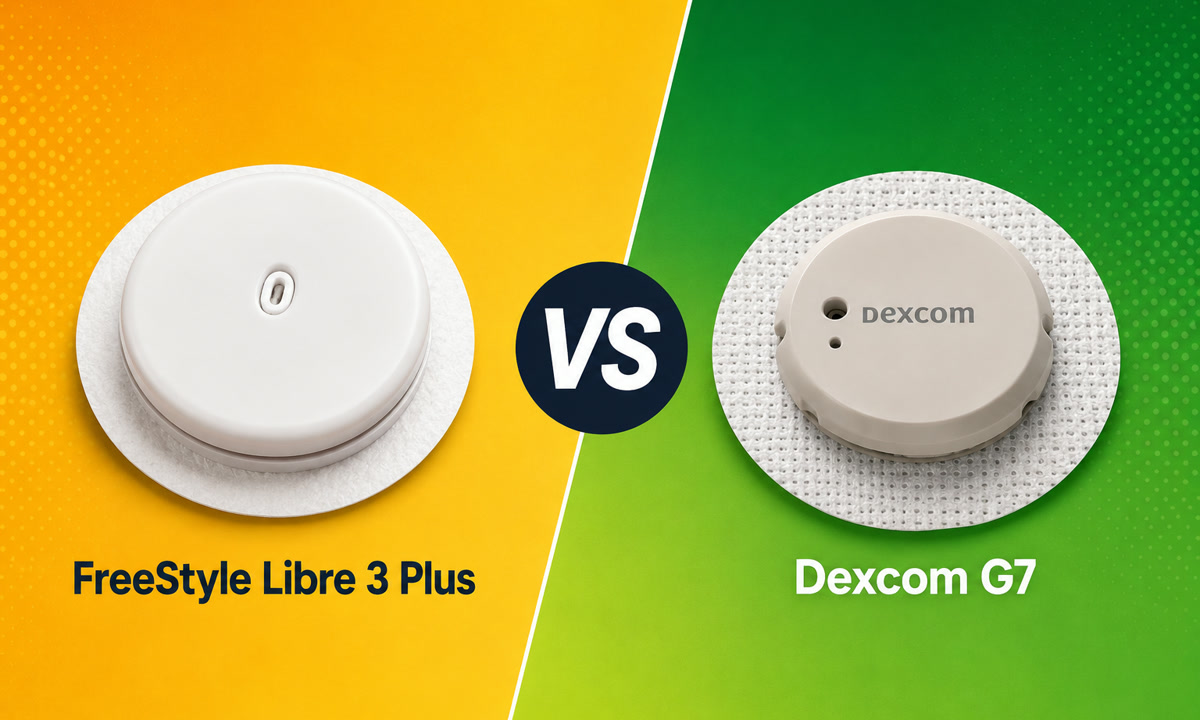
If you’re deciding on Libre 3 Plus vs Dexcom G7, the short answer is that published accuracy is effectively a tie. Both Abbott and Dexcom report overall accuracy around 8 percent MARD, so the real choice comes down to wear time, warmup, how often readings update, Apple Watch support, and how easily caregivers or family can follow along. For most CGM users, plus caregivers and clinicians helping choose between these systems, those day-to-day differences matter more than the small gap you’re likely to see on a spec sheet.
What actually changes your week: Libre 3 Plus runs 15 days with a 60-minute warmup and no grace period, while G7 warms up in 30 minutes and adds a 12-hour cushion at the end of its session. We’ll also look at how each system handles phone app use, Apple Watch compatibility, family sharing, and what it means if you’re moving from Libre 3 to Libre 3 Plus: the details that shape sensor changes, real-time monitoring, device fit, and caregiver alerts.
The short version, before the detail:
- Published accuracy sits around 8 percent mean absolute relative difference (MARD) on both sides.
- Libre 3 Plus: 15-day sensor, 60-minute warmup, a reading every minute.
- Dexcom G7: 10-day sensor plus a 12-hour grace period, 30-minute warmup, a reading every 5 minutes.
- G7 can talk straight to an Apple Watch; Abbott’s watch support depends on your app version and country. Either way the sensor does the measuring: an Apple Watch cannot measure blood sugar by itself.
- Libre 3 Plus is Abbott’s successor to Libre 3, using the same phone app and the same reader.
On this page
Accuracy: what each manufacturer actually publishes
Dexcom publishes an overall MARD of 8.2 percent for G7 in adults, and Abbott publishes a figure near 8 percent for the FreeStyle Libre 3 family. Lower percentages in Mean Absolute Relative Difference indicate higher accuracy, but on paper that gap is still smaller than the difference you would see between two fingersticks taken a minute apart.
MARD gets treated like a scoreboard, so it helps to know what it measures: how far a sensor’s glucose readings sit from a laboratory reference, on average. At a true value of 100 mg/dL (5.6 mmol/L), a MARD of 8 percent works out to roughly 8 mg/dL of typical error in either direction. At a true 250 mg/dL (13.9 mmol/L), the same 8 percent is about 20 mg/dL. So one headline number feels tighter when you are low and looser when you are high, and Abbott also publishes a 9.4 percent figure for children ages 6-17 as a subgroup result rather than the main head-to-head takeaway.
Averages also hide the edges. Both companies report accuracy separately for the low range, and both break out performance by day of wear in their user guides, where the first and last days are not always identical to the middle and may be when some users notice more erroneous readings. Both systems are also cleared by the FDA as integrated CGMs, a category with specific accuracy requirements including performance in hypoglycemia, and Dexcom G7 is FDA-cleared for treatment decisions without fingersticks while Libre carries the same practical point here. That clearance is a large part of why either one can be used to make treatment decisions without routine confirmatory fingersticks.
What moves cgm readings in real life is rarely the spec sheet. Lag between blood and interstitial fluid, pressure on the sensor while you sleep, a fast rise after food: all of it puts daylight between a sensor number and a meter number. If that mismatch bothers you, the mechanism is explained in more detail in why your CGM reading differs from your finger stick, and pressure artifacts get their own write-up in what a compression low is. Both devices can produce them. Neither is doing anything wrong when they do. Most systems are factory calibrated and do not require user calibration.
If the number on screen does not match symptoms, use a fingerstick to check before acting on it. Real-world glucose values can also shift with body-side pressure, plus sensor interference and resistance features that affect sensor performance. Accuracy is not the only practical concern, either, since sensor size and profile also shape comfort and preference.
| FreeStyle Libre 3 Plus | Dexcom G7 | |
|---|---|---|
| Wear time | 15 days | 10 days, plus a 12-hour grace period |
| Warmup | 60 minutes | 30 minutes |
| Readings | Every minute | Every 5 minutes |
| Published accuracy (MARD) | About 8 percent | 8.2 percent in adults |
| Apple Watch | Depends on app version and country | Native Apple Watch app with a direct Bluetooth connection |
| Family sharing | LibreLinkUp | Dexcom Share, up to 10 followers in Dexcom Follow |
Wear time, warmup and grace periods
Libre 3 Plus is a 15-day sensor with a 60-minute warmup, and FreeStyle Libre 3 does not offer a grace period, so when the session ends, it ends. G7 is a 10-day sensor with a 30-minute warmup and a 12-hour grace period after day 10, and that cushion buys you half a day to change at a convenient time rather than at 2 a.m.
Put a month against those numbers and the practical picture appears. Both are continuous glucose monitoring systems that stream readings automatically without manual scanning, so this is really a comparison of wear time, warmup, and how long each device keeps real-time data flowing. Over 30 days, Libre 3 Plus means two sensor changes, about two hours of total warmup with no live data, and readings every minute once a new sensor is running. G7 over the same month means three changes and about 90 minutes of warmup. One has a longer sensor life and a longer sensor lifespan, which means fewer sensor replacements; the other gives you less blind time and a friendlier end-of-session window. That is genuinely a preference, not a winner.
Dexcom has also received FDA clearance for a 15-day version of G7, which narrows the wear-time gap considerably as it rolls out through pharmacies and distributors. Availability varies by country and by supplier, so the sensor sitting in your box may not match the newest press release. Check the label on what you are actually prescribed.
Two smaller differences come up a lot in support questions. The grace period is not a bonus reading day: it is a defined window on G7 and it does not exist on Libre 3 Plus, so plan your changes differently on each. And warmup behaves the same way on both cgm systems in one respect: alarms are quiet until the sensor is running. That is exactly why many people schedule a change for the early evening rather than at bedtime.
How do the phone apps and Apple Watch support differ?
G7 sends a reading every 5 minutes, has a native Apple Watch app, and supports a direct Bluetooth connection to a compatible Apple Watch, so numbers keep arriving for a while when your phone is not nearby. The Libre 3 Plus smartphone app receives a reading every minute, while Dexcom’s smartphone app shows current glucose with a trend arrow using real time data over Bluetooth data transmission, and Libre keeps the phone at the center of the setup, with widgets and alarms on iOS. Both sensors are approved for the upper arm, and differences in sensor size, profile, and arm placement can affect comfort and day-to-day sensor wear. Libre 3 Plus is the smaller of the two (Abbott compares it to two stacked pennies) while G7 sits closer to a couple of stacked quarters, which some people will notice as a discretion point more than a clinical one. Abbott’s Apple Watch support has been rolling out by region, so iPhone users should confirm what your country’s app store listing offers before assuming Libre watch features match G7’s direct-watch experience.
Minute-by-minute data sounds like a big advantage, and for watching a fast fall it does feel different. For statistics, it barely matters. Take a target of 70 to 180 mg/dL (3.9 to 10.0 mmol/L) and a Time in Range of 70 percent: that is about 16 hours 48 minutes inside range and just over 7 hours outside it, whether the underlying day was built from 288 five-minute points or 1,440 one-minute points. The number you report to your clinic lands in the same place. If you want the reasoning behind that 70 percent figure, it comes from the 2019 International Consensus on Time in Range published in Diabetes Care, and it is unpacked in Time in Range explained.
Alarms are where the two apps feel most different day to day. Dexcom’s app offers customizable alerts for glucose levels, including high glucose and low glucose thresholds, schedules, different thresholds for night, and a predictive urgent low warning with real-time alerts. Abbott’s Libre 3 Plus app offers simpler alert systems with high, low and signal-loss alarms. The extra flexibility can help safety, but it can also add alert fatigue compared with Abbott’s simpler setup. Neither approach is objectively better. But if you know you are the kind of person who silences a repeating alarm at 3 a.m., read the alert settings screen carefully before you commit to a system. Practical wrist setup for either one is covered in CGM on Apple Watch. When a G7 number on the wrist goes stale, Dexcom G7 not updating on Apple Watch walks through the fixes.
One more compatibility note. Both sensors work with automated insulin delivery systems from several pump makers, but the supported pairings differ by device, software version and country. That single fact decides the question for a lot of pump users before accuracy or wear time gets a vote. Your clinic will know which combinations are approved where you live.
Family sharing on each system
Libre 3 Plus shares through LibreLinkUp: the wearer sends invitations from the Libre 3 app, and followers see readings and receive notifications in a separate free app. Dexcom shares through Dexcom Share on the wearer’s phone, feeding up to 10 people using the Dexcom Follow app. In other words, both are built around remote data sharing, not broader health-platform sync like Apple Health.
Underneath, both work the same way. The sensor talks to the wearer’s phone, the phone uploads glucose data to the manufacturer’s cloud, and the follower’s app pulls it down for delivery to followers. So an internet drop on either end pauses the follower view, and a follower alert always runs a little behind the wearer’s own alarm. It is a second layer, never the first one.
The differences are in the details. Dexcom Follow lets each follower set their own alert thresholds and gives caregivers a familiar trend graph; the split between the two Dexcom features confuses almost everyone at first, which is why Dexcom Share vs Dexcom Follow exists. On the Abbott side, LibreLinkUp pairs with the Libre app the wearer uses and supports a generous number of connections, making it the standard route for a parent or partner, walked through step by step in how to share Libre readings with family.
For school days and overnight coverage, ask one question of whichever system you pick: does the person who needs to act actually receive a sound they will hear? A silent notification on a muted phone in a bag is not remote monitoring. Reliable sharing matters most when a caregiver, parent, or healthcare provider needs timely information for managing diabetes and supporting effective diabetes management.
Is the Libre 3 being replaced by the 3 Plus?
Yes. Abbott introduced FreeStyle Libre 3 Plus as the successor sensor, stretching wear from 14 to 15 days while keeping the same phone app, the same reader compatibility and the same one-piece applicator. It sits as Abbott’s latest option among other CGM systems rather than a separate platform. Supply has been shifting to 3 Plus rather than running both forever.
In practice, a prescription written for “FreeStyle Libre 3” often gets filled with 3 Plus sensors, and both generations pair with the same app, so nothing changes on your screen except the session length. If your pharmacy still has original Libre 3 stock, it is not expired or inferior. It is simply the earlier version. Ask your team to confirm the wording on your prescription if you use an automated insulin delivery system, since integrations are specified by exact sensor name: Dexcom G7 works with the Tandem t:slim X2 insulin pump, Omnipod 5, and the iLet bionic pancreas, while on the Abbott side the same t:slim X2 now supports FreeStyle Libre 3 Plus specifically, in the United States and a growing list of European countries, and the original Libre 3 sensor is not part of that pairing. That naming detail matters in connected systems.
So how should you choose? If you want the fewest sensor changes and a one-minute data stream, Libre 3 Plus fits. If you want a native watch app, per-follower alert thresholds and an urgent-low-soon warning, G7 fits. Pump users usually get the answer handed to them by the supported pairing. On price and coverage, Dexcom G7 is covered by Medicare for eligible patients, most patients pay $0, and uninsured cost is about $89 monthly; FreeStyle Libre 3 more often lands around $0 to $75 monthly with insurance and $80 or more for many cash-pay patients. Confirm the details with your insurance provider, especially if you have commercial insurance or access to a free benefits check.
If you want a second, independent view of either sensor’s numbers on your phone and wrist, that is what we built Sugar Sense for.
This article is educational and general. Sugar Sense is a companion app: it does not replace your Libre or Dexcom system, its own alarms, or the readings you rely on to act, and no comparison here should be read as a recommendation to switch devices or a substitute for professional medical advice. Anything involving your treatment belongs with your diabetes care team, and our medical disclaimer spells out the limits of what we publish.