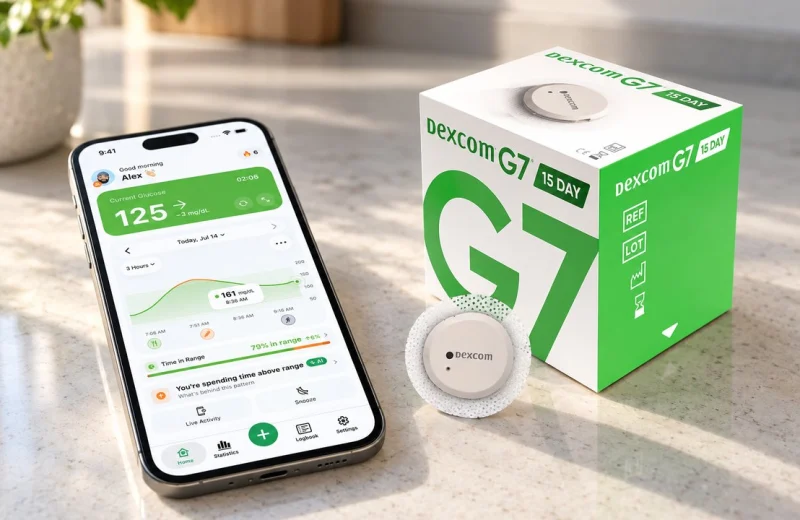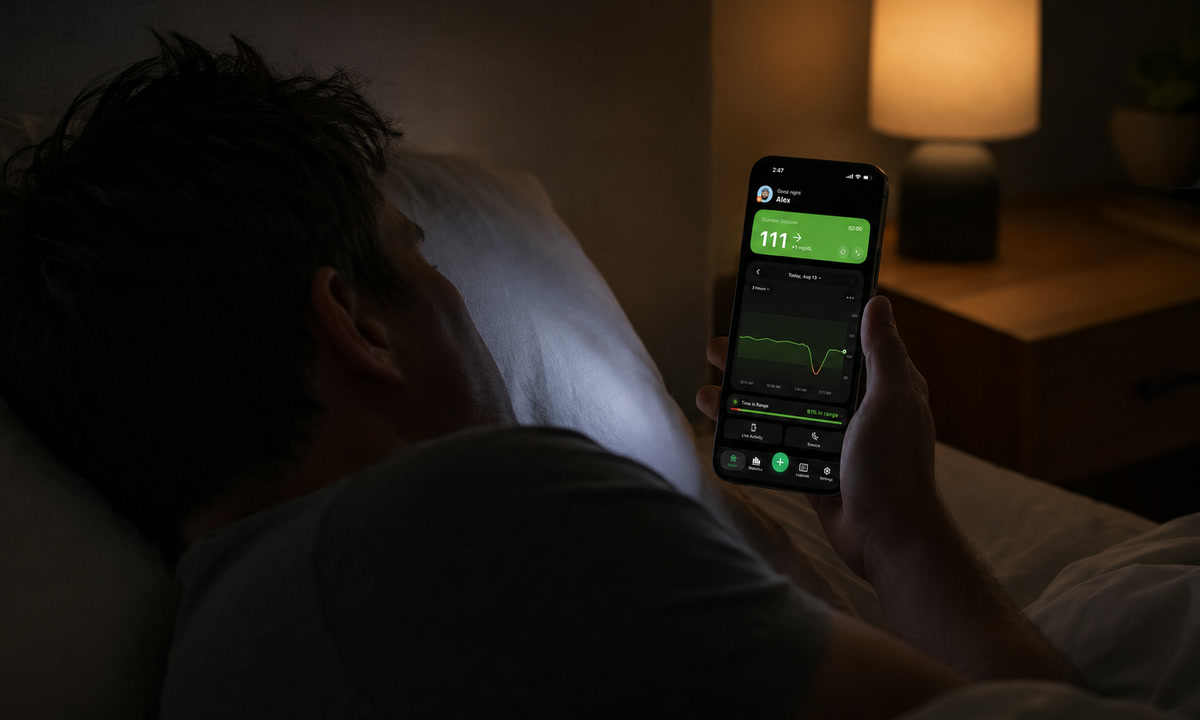
A compression low on a CGM is a false low reading caused by steady pressure on the sensor site, most often your own body weight while you sleep. Your real blood sugar is fine. The number usually climbs back on its own within 15 to 60 minutes once the pressure comes off.
For people with type 1 or type 2 diabetes using a CGM, and for the parents, partners and other caregivers following those readings, this matters because a false overnight low can trigger alarms, stress and unnecessary treatment. Here is the part that matters most: nothing in the number itself tells you which kind of low you are looking at. So the response stays the same either way. Shift off the sensor, check with a meter if you can, and treat only what you confirm.
This guide explains how to tell a compression low from a real low, what tends to trigger it, how to reduce repeat episodes with sensor placement and sleep-position changes, what the alerts can and cannot tell you, what Dexcom and Abbott say about it, and where Sugar Sense fits at 3 a.m.
Pressure, not glucose: a compression low is your sensor reporting a squeezed patch of tissue, not your bloodstream. It rebounds without food, but you still confirm before you decide anything.
On this page
What causes a compression low on a CGM?
Firm, sustained pressure narrows blood flow in the small area right around the sensor filament, so less glucose reaches the fluid the sensor is sampling. CGMs measure glucose in interstitial fluid, the fluid between cells, rather than in blood directly, which is why local circulation moves the number at all. The NIDDK explains how CGMs measure interstitial glucose through a thin filament sitting just under the skin. Calibration problems can also throw a CGM off, but compression is a separate, local pressure effect.
Squeeze that patch of tissue for twenty minutes and the sensor honestly reports what it sees there. Not a device fault. Just a local effect, and nothing that is happening in the rest of your body.
Where the pressure usually comes from
Body weight during sleep causes most compression lows, which is why they are also called pressure lows or overnight false lows. Most people meet them in the middle of the night, when a sleeping position pins the sensor. Daytime versions exist. They are just rarer, because you move.
- Sleeping in a position that presses on the sensor
- An arm tucked under a pillow, your head or your torso
- A tight waistband or belt over an abdomen sensor
- Leaning against a car door, armrest or hard chair back for a long stretch
- A backpack strap or seatbelt resting right on the sensor
- A toddler asleep on that exact arm
Overnight lows are often positional, and they become obvious once you notice what you were lying against.
How to tell a compression low from a real low
Look at the shape of the glucose graph, not the digit. A compression low tends to plunge fast to a low number, sit there for a short time, then snap back toward where it started with no food involved. A real low usually has a cause behind it and a slower, messier recovery.
| Clue | Compression low | Real low |
|---|---|---|
| Shape on the graph | Steep drop, sharp V, quick rebound | Gradual slide, flatter bottom |
| How you feel | Usually nothing at all | Often shaky, sweaty, hungry, foggy |
| Timing | While lying still, mostly at night | After activity or a missed snack |
| Recovery | Comes back up without carbs | Needs treatment to rise reliably |
| Position | You were lying on the sensor side | Position is irrelevant |
A worked example. You fall asleep at 118 mg/dL (6.5 mmol/L) with a flat arrow. At 2:05 a.m. the trace falls off a shelf: 96, then 71, then 54 mg/dL in about twenty minutes, and the low alarm fires. You roll onto your other side, drink nothing, eat nothing. By 2:40 the line is back at 109 and flat again.
A thirty-five minute round trip, no carbs, straight-line recovery. That is pressure. For scale, 35 minutes is roughly 2.4 percent of a 1,440 minute day, so a few of these a week visibly dents your Time in Range without anything happening to your actual glucose.
If the meter is normal and you feel fine, the CGM can still show a false low because it tracks fluid under the skin, not blood, which I unpack in why your CGM reading is different from your finger stick.
Should you treat a compression low?
Treat what a meter or your symptoms confirm, never what a suspicious dip suggests on its own. Fast carbs for a low that was never real can push you high an hour later, and ignoring a genuine low is the more dangerous mistake of the two. So the rule is confirm, then act.
- Notice your body first. The CDC lists shakiness, sweating, a fast heartbeat, confusion and hunger among the common signs of low blood sugar.
- Take the pressure off. Roll over, free the arm, loosen the belt.
- Do a finger stick if you have your meter within reach, especially if you feel fine but the number looks suspiciously low.
- Wait a few minutes and watch the next readings for recovery before deciding. A pressure low starts climbing on its own.
- Treat if the meter or how you feel says the low is real, following the plan your care team gave you.
The 2019 International Consensus on Time in Range counts every reading below 70 mg/dL (3.9 mmol/L) as time below range and anything under 54 mg/dL (3.0 mmol/L) as clinically significant hypoglycemia, and that consensus on CGM targets is a good reason to take every alert seriously enough to check. Suspecting pressure is not the same as knowing.
How to avoid compression lows at night
You cannot control how you move at 3 a.m. But sensor placement does most of the work here. Put the sensor on the side you sleep on least and the problem shrinks fast.
- Favor your non-sleeping side. Right-side sleeper, left arm. And the reverse.
- Use the back of the upper arm within the zone your manufacturer approves, which takes less direct weight than the front for many people.
- Rotate sites every sensor, staying inside the approved areas for your device; rotating also gives each spot time to recover.
- Hug a body pillow so you stop short of rolling fully onto the sensor arm.
- Check what is under the arm. A heavy arm wedged beneath a pillow or a firm mattress adds more pressure than people expect.
My own routine is plain alternation: every new sensor goes on the opposite arm from the last one. I do not really favor a side in my sleep, so for me this steady rotation does the work that picking a “safe” arm does for others, and no single spot takes my body weight night after night.
If pressure lows keep pulling you out of sleep, bring the overnight graphs to your diabetes care team. Patterns are easier to read together.
Dexcom compression lows: G6 and G7
Dexcom addresses this directly on its support site. Its answer to why a Dexcom G6 says low at night when the meter shows otherwise is that something is pressing on the sensor, that the readings should move back toward your meter once the pressure is relieved, and that the fix is placement: choose a sensor site that will not be bumped, pushed or laid on while sleeping. The same physics applies to the G7.
One display detail worth knowing: the G7 reports glucose from 40 to 400 mg/dL and shows LOW instead of a number when its estimate drops below 40. A LOW on the screen at 3 a.m. is the same question as any other overnight low. Take the pressure off, confirm with a meter, treat only what is real, and never assume it is pressure just because you were lying on that arm.
FreeStyle Libre 3 false low readings at night
Libre 3 and Libre 3 Plus sensors sit on the back of the upper arm, so a side sleeper’s own weight is the usual cause of a nighttime false low, and the check is the same: move, wait a few minutes, confirm with a finger stick. The Libre apps show LO when a reading is below 40 mg/dL, and the instruction Abbott gives for a LO result is to check your blood glucose with a test strip.
One more thing to rule out in 2026. In November 2025 Abbott began a medical device correction for certain FreeStyle Libre 3 and Libre 3 Plus sensors sold in the United States, because some sensors from one production line may give incorrect low readings that have nothing to do with pressure. The FDA notice asks users to check their sensor at FreeStyleCheck.com, to stop using and dispose of a sensor confirmed as affected (Abbott replaces it free of charge), and to use a blood glucose meter whenever sensor readings do not match how you feel. So if your Libre 3 keeps reading low at night even when you are clearly off the sensor, check the serial number before you blame your pillow.
Do compression lows set off alarms?
Yes, and they should. No sensor or companion app can distinguish a squeezed patch of tissue from falling blood sugar, so the alarm sounds either way and hands the judgment call to you.
Nighttime lows have been my own long-running problem, and there were nights when a single alarm did not wake me. That is exactly why I wanted a second, independent layer of alerts on top of the sensor’s own app, and why I would rather answer a few false alarms than sleep through one honest one.
For families watching remotely, a 3 a.m. drop on someone else’s graph is its own kind of stress. Looking back over a couple of weeks of overnight graphs makes a repeated pressure pattern obvious, which lets a caregiver stay calm: confirm first, treat only what is real. My caregiver’s guide to remote glucose monitoring covers how to set alerts that stay useful instead of exhausting.
Are some sensors more prone than others?
Every continuous glucose monitor can show compression lows, because every CGM measures interstitial fluid through a filament under the skin. A CGM compression low is a physics problem, not a brand problem: placement and sleep position matter far more than the name on the box.
Both Abbott and Dexcom spell out approved wear sites and placement guidance in their user guides, and following that guidance is the most useful lever you have. Filtering algorithms differ between generations and may smooth brief pressure differently. But no sensor is immune, and I have seen these dips on both Libre and G7 sensors myself.
Frequently asked questions
How long does a compression low last?
Most compression lows rebound within 15 to 60 minutes. Once you move off the site and normal blood flow returns near the filament, the reading climbs back toward your true level with no treatment at all. If the line does not recover after you move, stop assuming it is a false low. Anything still low after an hour deserves a meter check.
Can a compression low damage my sensor?
Nothing happens to the hardware. Pressure changes what the filament can measure for a while, not the sensor itself, and readings return to normal once you shift position. Repeated pressure on a tender site can make the spot sore, which is a separate reason to rotate. A sensor that has come loose can also read unreliably, and that is a different problem from compression.
Should I turn off my low alarm to stop nighttime false alerts?
That removes your safety net against real overnight lows, which is a bad trade for quieter nights. Better moves: move the sensor to the side you sleep on less, adjust the alert settings rather than switching alarms off, and keep a meter on the nightstand so confirming takes ten seconds.
Where should I put my CGM to avoid compression lows?
Inside the sites your manufacturer approves, on the side you sleep on least. Dexcom’s advice is a spot that will not be bumped, pushed or laid on while sleeping. For the back-of-the-arm sensors that usually means the arm you do not sleep on, and switching arms with every new sensor so no single spot takes your weight night after night.
Can Dexcom give false lows?
Yes, from pressure on the sensor, which Dexcom describes on its own support pages. The number is the sensor’s honest reading of a squeezed patch of tissue, not a device fault, and the check is always the same: take the pressure off, wait a few minutes, confirm with a meter before you treat.
What does LOW mean on a Dexcom?
The G7 reports 40 to 400 mg/dL; below 40 it shows LOW instead of a number, and the Libre apps show LO for the same situation. Treat LOW as real until a meter says otherwise. A compression low can push the display all the way down there too, so confirm rather than assume.
Why is my CGM constantly reading low?
A compression low is a sharp dip that recovers within an hour once you move. A sensor that reads low all day, while you are awake and moving, is a different problem: a sensor that has come loose, a calibration issue, or, for certain Libre 3 and Libre 3 Plus sensors, the Abbott correction described above. Compare with a meter, and read why a CGM reading differs from a finger stick.
Where our app fits at 3 a.m.
Sugar Sense puts the live number and the trend on your wrist and on your Lock Screen, which is usually enough to tell a rebounding V from a real slide before you are fully awake. It reads the data from the CGM you already wear rather than replacing it, so the sensor’s own alarms keep doing their job. Have a look at how Sugar Sense handles overnight alerts.
Everything above is general education from someone who lives with type 1, not medical advice for your situation. A companion app like ours adds a view and an extra alert layer; it does not stand in for your CGM, its sensor or its built-in alarms, and it cannot confirm a low for you. Bring treatment and medication questions to your healthcare team, and see the full disclaimer here.