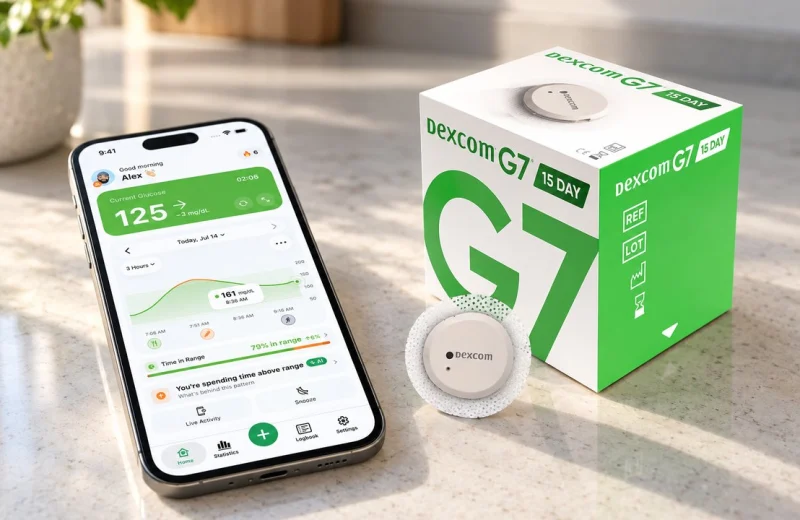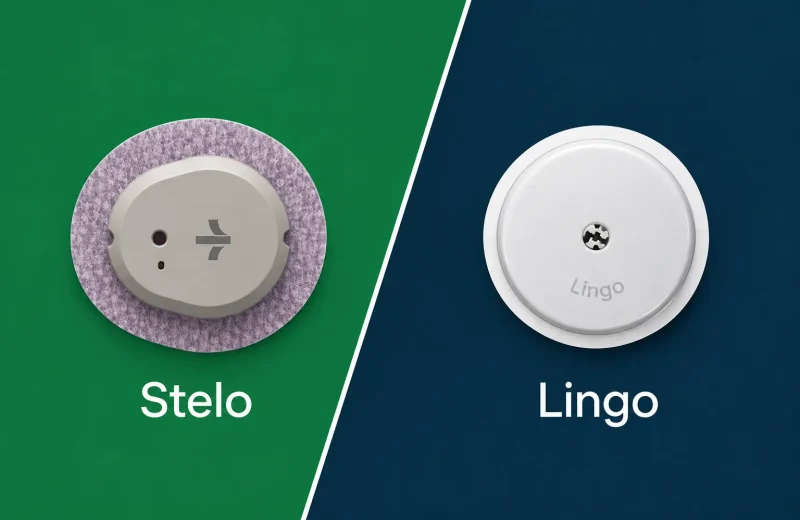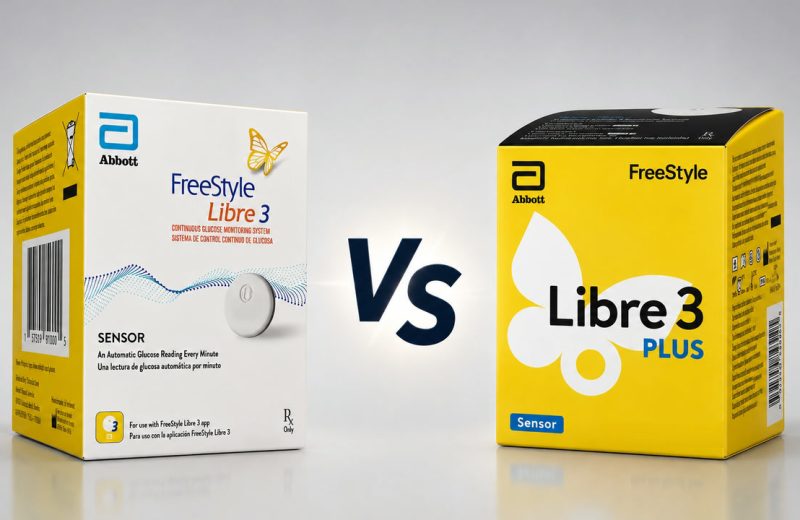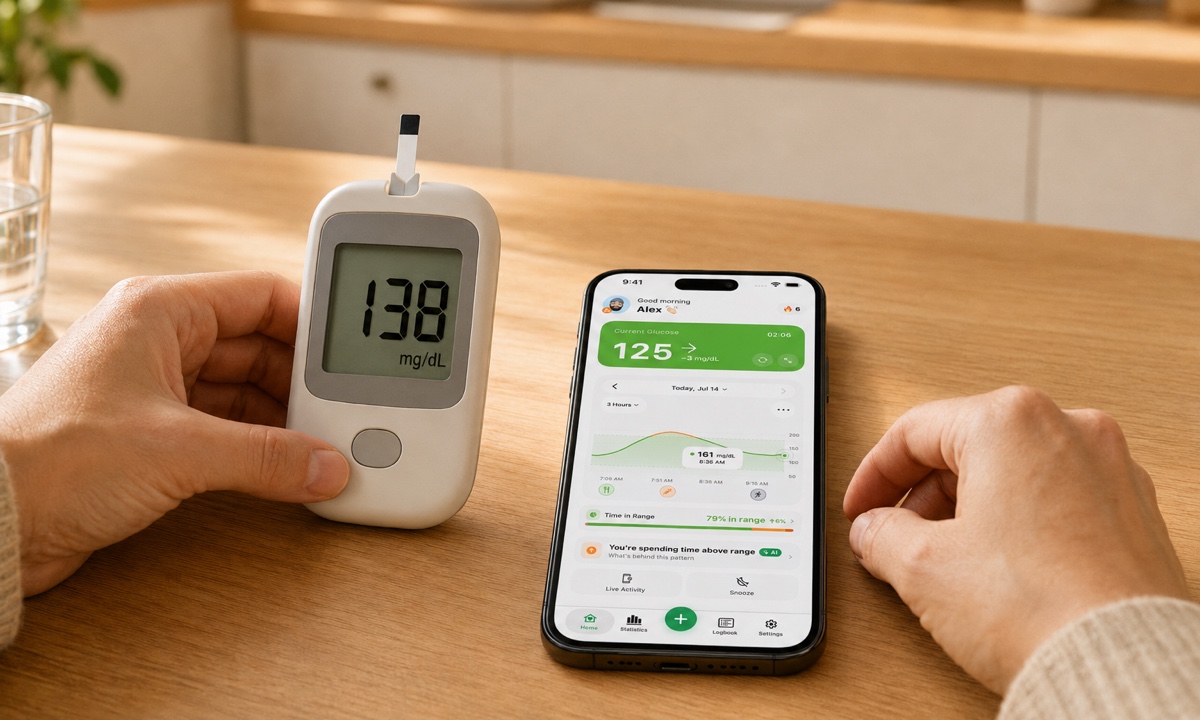
Your CGM alarms at 62 mg/dL (3.4 mmol/L). You feel completely fine, so you wash your hands, prick a finger, and the meter says 78 mg/dL (4.3 mmol/L). Which one is lying?
Neither, usually. CGM versus finger stick accuracy is a question of two different fluids measured at two different moments, not of one device being right. The meter reads glucose in blood right now. The sensor reads glucose in the fluid between your cells, which trails blood by roughly 5 to 15 minutes. A gap of 15 to 20 percent is ordinary.
If you wear a Dexcom or a Libre, or follow someone else’s numbers as a caregiver, the gap matters most exactly when decisions feel urgent: during lows, overnight alerts, and fast rises or drops. This guide covers why the numbers drift, how far apart is normal, the accuracy figures the manufacturers publish, calibration, the mismatches that are not lag, and when the meter wins.
The fast version, before the detail:
- Blood glucose and interstitial glucose are two different measurements, not two attempts at the same one.
- The two disagree most while your glucose is climbing or dropping quickly.
- A meter reading 100 mg/dL against a sensor reading 115 mg/dL is normal performance, not a broken sensor.
- Pressure on the sensor overnight can produce a low that never happened.
- Symptoms that clash with the number are the moment to reach for the meter.
On this page
Why the two numbers drift apart
A finger stick measures a drop of blood directly. A CGM filament sits in the interstitial fluid just under your skin, and glucose has to move out of your capillaries into that fluid before the sensor sees it. That is why the National Institute of Diabetes and Digestive and Kidney Diseases describes CGM values as reflecting glucose in the fluid between cells rather than in blood.
When you are flat, the delay barely shows. When you are moving, it shows a lot. Your sensor is telling you accurately where you were a handful of minutes ago; your meter is telling you where you are. Both can be true at once.
Sensor smoothing adds a little to this too. Manufacturers filter the raw signal to keep the trend line readable, and filtering always costs a bit of immediacy.
| What your glucose is doing | Likely gap | How to read it |
|---|---|---|
| Flat, no arrow, no recent food or insulin | Small | Best moment to compare the two devices fairly. |
| Climbing after a meal | Meter often higher than CGM | The sensor is catching up. Expect it. |
| Dropping during or after exercise | Meter often lower than CGM | The real number may already be below the screen. |
| Recovering after you treat a low | Meter higher than CGM | The sensor lags the rescue carbs by minutes. |
| First hours of a fresh sensor | Wider and less predictable | Let warm-up finish before you judge anything. |
Direction matters more than the digit here. If you are not sure how to read the arrows next to your number, our guide to glucose trend arrows covers what each one means in practice.
How far apart is normal?
Roughly 15 to 20 percent difference from a lab-quality result counts as good CGM performance, and the current sensors average better than that (the published numbers are in the next section). So a 15 mg/dL disagreement in the middle of your range is unremarkable.
The math is worth walking once, because percentages behave strangely at the two ends of the scale.
- At 200 mg/dL (11.1 mmol/L), a 20 percent spread is 40 mg/dL. Your meter could read 165 and nothing is wrong.
- At 70 mg/dL (3.9 mmol/L), a 20 percent spread is only 14 mg/dL. Meter 71 against sensor 60 is the same relative accuracy, and it feels far more dramatic.
That is why low readings generate most of the “my devices disagree” panic. In absolute terms the sensor is doing fine. In decision terms, 60 and 71 feel like different worlds, and both sensors and meters are at their least precise down there. The honest answer: near your low threshold, lean on how you feel and on a meter, not on the last digit of either device.
Your meter is not a perfect referee either. The benchmark for home meters is that 95 percent of readings land within 15 percent of a lab result (the ISO and FDA accuracy criteria), and a trace of fruit juice or a badly squeezed finger will move a result more than most people expect. I read in mg/dL and I still get the occasional meter number that makes no sense at all until I wash my hands and try again.
What MARD means, and the numbers Dexcom and Abbott publish
MARD, mean absolute relative difference, is the average percentage gap between a sensor’s readings and a lab reference across a whole study, so lower is better. Dexcom publishes 8.2 percent for the G7 in adults and 8.0 percent for the G7 15 Day; Abbott publishes 7.9 percent for the FreeStyle Libre 3.
Those are averages over thousands of paired readings. Any single comparison can sit well outside them, especially during a fast change or on day one, which is what the table above is for. Home meters are held to a different yardstick (the 15 percent rule), so the two figures are not directly comparable, and “which is more accurate” has no single answer.
Dexcom’s 20/20 rule, and what Abbott says about mismatches
Dexcom gives its users a concrete check, the 20/20 rule: with your glucose stable, the sensor should sit within 20 percent of the meter when the meter reads 80 mg/dL or higher, and within 20 mg/dL when it reads lower. A meter at 100 with a sensor anywhere from 80 to 120 is a match.
Abbott’s guidance for Libre says much the same in words: sensor and blood readings will not always match, the gap is widest when glucose is changing fast, and its labeling makes a fingerstick the tie-breaker whenever readings or alarms do not match your symptoms.
Gaps that are not just lag
Some mismatches have a real cause you can act on. Pressure on the sensor is the most common one. A compression low happens when you lie on the sensor and squeeze fluid away from it, so the graph shows a sharp drop that your blood never took. Roll off, and it usually recovers on its own within 20 to 30 minutes.
Signs it was compression and not a real low:
- A steep drop with no insulin, no exercise and no missed meal behind it.
- You woke up on the side where the sensor sits.
- The line climbs back to where it was, quickly, without treatment.
Nighttime alarms that do not match a finger stick are the classic case, and compression is behind a large share of them. Our deeper explainer on compression lows and how to reduce them goes through placement and sleeping position. Feel fine and suspect pressure? A finger stick settles it in 30 seconds.
Other avoidable sources of disagreement:
- Unfinished warm-up. Judge a new sensor after it has settled, not in its first hour.
- Poor application. Clean, dry skin, no lotion, an approved site with a little tissue cushion rather than muscle or bone.
- Unwashed hands. Wash and dry before every meter check.
- End of wear. Readings can wander in the final stretch of a sensor’s official wear period.
- Dehydration. Fluid balance affects the interstitial side of the measurement.
- Certain medicines and supplements. The two most asked about, acetaminophen and vitamin C, are covered in the questions at the end.
A single off comparison matters most when it repeats, or when it fits your symptoms or one of the causes above.
Calibrating a Dexcom G7, and why a Libre 3 cannot be calibrated
The Dexcom G7 does not need calibration, but it accepts an optional one. Dexcom’s own rules: only consider it when the sensor has sat consistently far above or below your meter for several hours, only with a flat arrow (a calibration entered during a rise or fall may be rejected, may ask you to recalibrate later, or may end the sensor early), and if you just want the meter value on the graph, log it as an event instead.
FreeStyle Libre 2 and 3 sensors are factory calibrated and take no user calibration at all. A persistent gap on a Libre is a reason to check the sensor, the site and the timing, not to enter numbers. Either way, your device instructions and your care team decide this one.
When to trust the finger stick over your CGM
Confirm with a meter whenever your symptoms and your CGM disagree. That is the rule device makers and the American Diabetes Association both give, and it covers almost every situation where the two numbers matter at once.
Reach for the meter when:
- You feel low or high and the sensor says you are fine.
- The sensor shows a value that does not fit anything you have done in the last hour.
- Your glucose is changing fast and you need an exact number for a decision.
- The sensor is brand new, near the end of its wear, or has been throwing errors.
Follow your own device’s labeling. Some sensors are cleared for treatment decisions without routine finger sticks and some are not, so your user guide and your care team decide that, not a blog.
The rest of the time, the trend is the more useful object on the screen. This is the part I care about personally: nighttime lows have been my own long-running problem, and there were nights when one alarm did not wake me. That is exactly why I wanted a second independent layer watching the direction of travel. Sugar Sense shows the live value and the arrow on my wrist, and when the line starts heading down while I am still in range, that warning arrives long before any single reading looks scary.
Still building the mental model behind all of this? How a CGM actually works explains the sensor side in plain language.
Frequently asked questions
How far behind is a CGM from a finger stick?
Roughly 5 to 15 minutes in physiology, plus whatever smoothing the app applies. When your glucose is flat the delay is invisible; during a fast rise or fall it is the whole story, because the sensor is reporting where you were, not where you are.
Should I calibrate my CGM to match my meter?
Only a Dexcom G7 takes one, and only under the conditions above; Libre sensors do not. Factory calibrated sensors should be left alone, and entering a meter value during a fast rise or fall can pull the whole trend line off for hours. Your device instructions and your care team decide this one.
Is the Dexcom G7 more accurate than a finger stick?
They are graded differently, so the question has no clean answer. A lab draw is the reference; a home meter must land within 15 percent of it 95 percent of the time; the G7’s published MARD is 8.2 percent averaged over a study. A well-used meter on a clean, dry finger is still the better single number, and the G7 is the better picture of the last three hours. Use each for what it is good at.
Does Tylenol affect Dexcom readings?
Not at the amounts on the box. Dexcom’s interference page says the G6 and G7 can still be used for treatment decisions at a standard or maximum acetaminophen intake; going above the labeled maximum can make readings look higher than they are. The one medication Dexcom rules out entirely is hydroxyurea, which pushes readings falsely high; if you take it, the sensor is not for treatment decisions.
Does vitamin C affect Libre readings?
It can. Abbott’s safety information says taking ascorbic acid above the maximum recommended daily allowance may falsely raise Libre sensor readings, and the same note covers salicylic acid (aspirin). The Libre 3 Plus sensor was modified to reduce the vitamin C effect, which is what made it eligible for automated insulin delivery systems; the labeling still carries the warning.
Why does my CGM read higher than my finger stick in the morning?
The dawn effect pushes glucose up in the early hours, and by the time you wake it is often already easing back down. A sensor smooths and slightly trails the change, so it can still show the earlier, higher value while a finger stick shows where your blood is right now. Persistent morning gaps are worth mentioning to your provider, along with anything odd you saw on the overnight graph.
Which is more accurate, a finger stick or a CGM?
A lab draw is the reference standard, a home meter sits close to it, and a CGM trades some point accuracy for something no meter gives you: direction, rate of change and a full night of data. Use each for what it is good at.
Does the lag matter while I am treating a low?
This is where it matters most. Fast carbs raise blood glucose before the sensor sees it, so the CDC’s advice to treat, wait about 15 minutes, then recheck exists precisely to stop over-treatment. Follow the plan your care team gave you, and see nighttime hypoglycemia signs for the overnight version of this problem.
Written to explain the technology, not to guide treatment. A companion app like ours sits on top of your CGM and never replaces the sensor, its own alarms or a meter, and any decision about carbs, insulin or medication belongs to you and your healthcare team. Our full disclaimer spells out the limits.