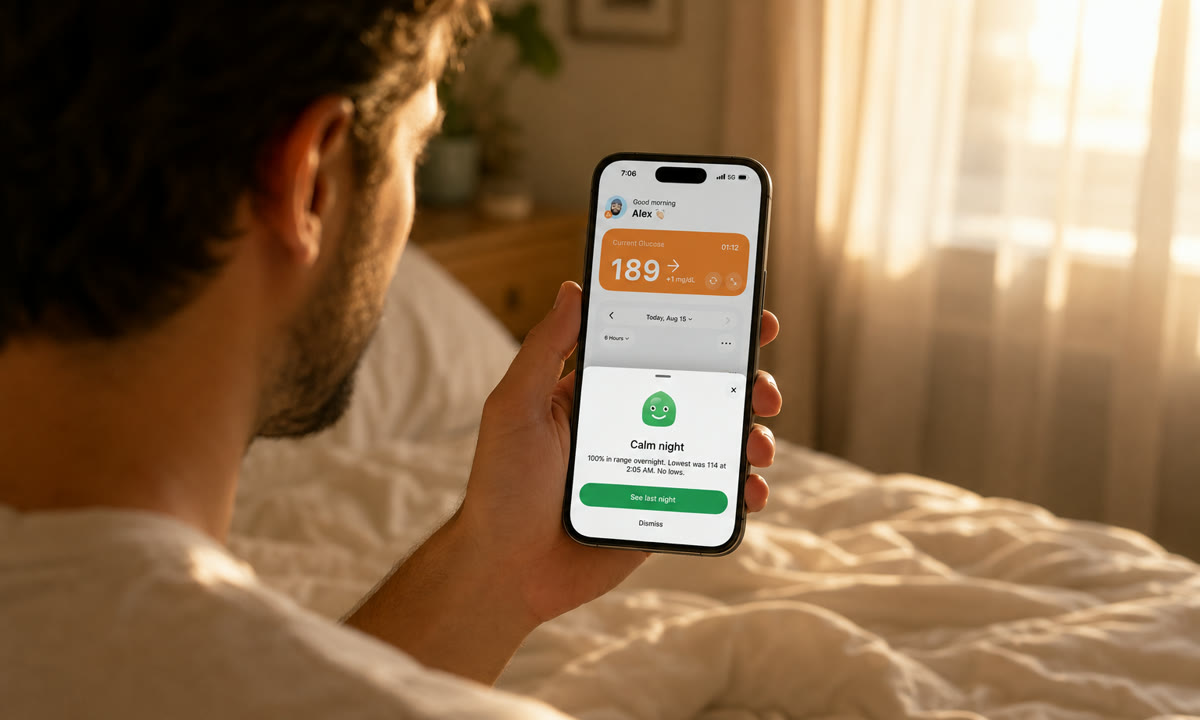
The dawn phenomenon is a natural rise in blood sugar in the early morning, roughly between 3 a.m. and 8 a.m., driven by hormones that get your body ready to wake up. Everyone has it. Diabetes is what makes it show up on the meter or CGM, because there is not enough insulin on hand to offset the glucose your liver releases.
The useful part is the shape it makes on a CGM: a flat, quiet night, then a slow climb with no food to explain it. Whether you wear the sensor yourself or follow a family member’s readings, that shape explains a lot of stubborn high morning blood sugar. One high morning proves nothing. A week of the same curve tells you something real.
The gist: An early-morning hormone surge tells your liver to release stored glucose, and in diabetes there is not enough insulin on hand to cancel it out. It is common and rarely an emergency, but the pattern is worth capturing on your CGM and taking to your care team.
On this page
What actually drives the dawn phenomenon
Cortisol, growth hormone and adrenaline rise in the last hours of sleep, and they prompt the liver to push stored glucose into the bloodstream so you have fuel to get up and move. That is the whole mechanism. A built-in alarm clock, not a malfunction.
In someone without diabetes, the pancreas answers the surge with a matching burst of insulin and the line stays flat. With diabetes, that automatic counter-move is missing or blunted. The extra glucose stays in circulation, and your 7 a.m. number lands higher than your bedtime number.
The size of the rise is personal. Researchers usually count it as a dawn phenomenon once the climb from the overnight low point to the pre-breakfast reading reaches 20 mg/dL (about 1.1 mmol/L). In a CGM study of 248 people with type 2 diabetes, the typical rise was 16 mg/dL and a quarter of the group climbed more than 30 (Monnier et al., 2013). The same hormone system is also why glucose can drift up during illness or a stretch of bad sleep, as the NIDDK notes in its guidance on managing diabetes.
Spotting the pattern in your overnight data
A CGM reports around the clock, typically a reading every one to five minutes. That is the only practical way to see the shape of a night instead of the single point a wake-up finger stick gives you. The NIDDK’s overview of continuous glucose monitoring describes that continuous sampling. New to CGM data? Start with how a continuous glucose monitor works.
A textbook dawn phenomenon night looks like this:
- Glucose sits reasonably steady from bedtime through most of the night.
- Somewhere after about 3 a.m., the line starts to tilt upward and keeps going.
- You wake higher than you went to bed, with no snack, no correction and nothing else that explains it.
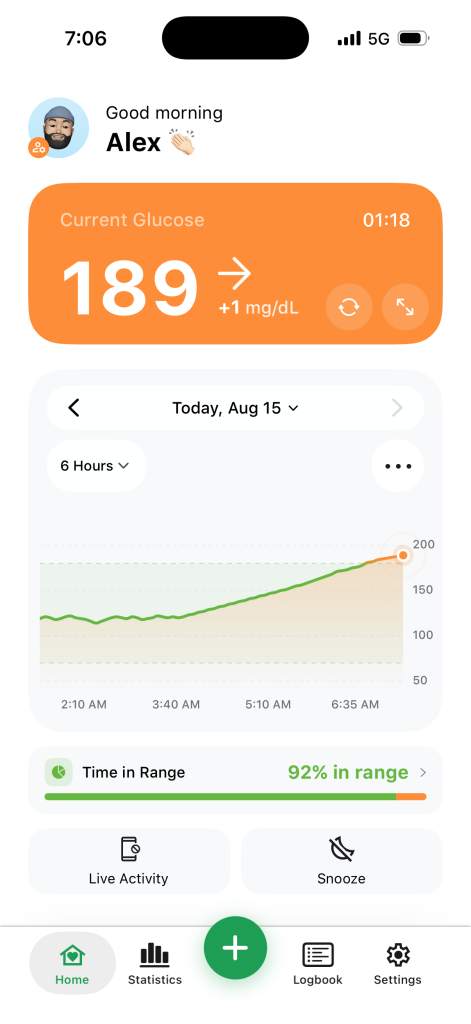
Do this for five or six nights before you draw any conclusion. Rising trend arrows in the early morning back up what the graph shows. They tell you how fast the climb is happening, not just that it happened. If you check with a meter instead of a CGM, the reading that settles it is the one in the middle of the night: StatPearls suggests a finger stick between 2 and 3 a.m., which together with the wake-up number shows whether the night was flat or dipped before it climbed.
I read my numbers in mg/dL, and nighttime lows have been my own long-running problem, so my habit is to scroll back through the whole night before I blame hormones for a high morning. What happened at 2 a.m. changes how I read 7 a.m.
Dawn phenomenon vs the Somogyi effect
Both leave you high at breakfast, but the route there is different. The dawn phenomenon is a hormone-driven rise with no low in front of it. The Somogyi effect is a morning high that follows an overnight low and the body’s overcorrection for it. The American Diabetes Association calls it a much rarer cause of morning highs than the dawn phenomenon. Your CGM graph settles the question, because it shows whether the line dipped before it climbed: a 2 to 3 a.m. reading that is normal or high points to the dawn phenomenon, a low there points to a rebound. One caution before you call a dip a low: a brief, sharp drop while you sleep on the sensor is often a compression low, not a real one.
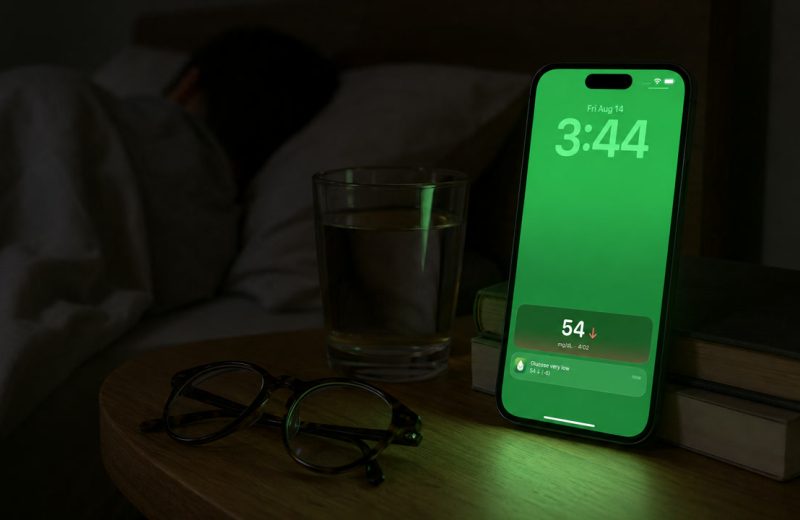
This distinction matters more than it sounds. Two nights can end at the same number and mean opposite things. If you see dips before the rise, read up on nighttime hypoglycemia warning signs, and know that overnight lows can pass without waking you at all, which is one reason the CDC treats low blood sugar as the pattern to catch first. A predictive low alert can flag a downward drift while you are still in range, hours before a rebound would ever show up at breakfast.
What makes the morning rise bigger or smaller?
Sleep, stress, illness, the timing and size of dinner and how much you moved the day before all push on the same hormone system. So the rise is not identical every night. These are general observations, not instructions. Anything involving medication belongs to you and your healthcare team, full stop.
- Late or very large dinners: glucose that is still elevated at midnight blends into the morning climb, so the two look like one long slope. An earlier or lighter dinner is one of the few levers that is yours alone to try, and worth mentioning to your provider.
- Short or broken sleep: less sleep means more stress hormones, and more stress hormones mean a steeper line.
- Illness and stress: both raise cortisol and adrenaline, the same players behind the dawn effect.
- Exercise: movement changes how your body handles glucose for hours afterward, and evening sessions can reshape the whole night in either direction.
Because these overlap, chasing a single morning number is mostly guesswork. Patterns are what you can act on with your provider.
Is a high morning blood sugar reading something to worry about?
An occasional morning rise is not an emergency, and the ADA says a one-off high has little effect on A1C. A rise that repeats most days is a different matter. It inflates the fasting number a lab draws in the morning, and it quietly eats into your Time in Range. The 2019 International Consensus on Time in Range set 70 to 180 mg/dL (3.9 to 10.0 mmol/L) as the common target band for many adults and suggested aiming for more than 70 percent of the day inside it (Battelino et al., 2019).
Here is what that costs in plain arithmetic. Say you go to bed at 130 mg/dL, hold near 120 until 3:30 a.m., then climb and cross 180 around 5:30, staying above it until you are back in range by 8:30. That is three hours above range. Three hours is 12.5 percent of a 24-hour day, so even a perfect rest of the day caps you around 87 percent, and two such mornings a week still show up in your monthly report.
Frequently asked questions
Does the dawn phenomenon happen every day?
The strength of the overnight hormone surge shifts with sleep, stress and activity, so many people see a clear climb on some mornings and a flat line on others. Not reliable, in other words. Cleveland Clinic describes it as usually a persistent issue, so the question is rarely whether it will stop and more often how big it is on a given night. A full week of overnight graphs tells you far more than any single morning does.
Do people without diabetes get the dawn phenomenon?
They do, and they almost never notice. The same hormones release stored glucose before waking, but a working pancreas matches it with insulin within minutes, so the glucose line barely moves and there is nothing to see on a meter.
Can it affect type 2 diabetes too?
Morning rises show up in both type 1 and type 2 diabetes, since the hormone surge is universal and the difference is only in how well insulin answers it. In type 2, insulin resistance blunts that answer, so the same surge lands higher. If you are new to sensors, our guide to using a CGM with type 2 diabetes covers what two weeks of wear can show. The ADA puts the dawn phenomenon at roughly half of people with either type, and StatPearls estimates the same. Timing and size vary a lot between people. Your own overnight data beats any general rule.
Does the dawn phenomenon raise A1C?
It can. In the CGM study of 248 people with type 2 diabetes mentioned above, the dawn phenomenon alone added about 0.4 percentage points to HbA1c and about 12 mg/dL to the 24-hour average glucose. If you watch a GMI from your CGM, a run of high mornings shows up there long before the next lab draw.
Does a high reading only in the morning mean diabetes?
Not by itself. A diagnosis rests on lab tests read by a clinician. For a fasting plasma glucose test, the ADA’s cut-offs are under 100 mg/dL for normal, 100 to 125 mg/dL for prediabetes and 126 mg/dL or higher for diabetes. A meter or CGM reading is a reason to ask for the test, not the test itself.
Should I treat a high morning reading right away?
Treatment decisions, including anything involving insulin or other medication, belong with your healthcare provider. What helps is arriving at your appointment with several nights of overnight CGM curves plus notes on dinner, sleep and the wake-up number, so the two of you are reading the same picture.
Where our app fits in
Seeing the pattern is most of the work. Sugar Sense keeps your overnight history, Time in Range and a logbook in one place on your iPhone, Android phone and Apple Watch. Add a one-line note about dinner or a rough night, and by the weekend you can tell whether your morning blood sugar really is climbing on its own.
Before you go: this is general education about a common glucose pattern, not medical advice, and nothing here should change how you use your insulin or other medication. Sugar Sense reads and displays your CGM data; it does not replace your sensor, its own app or its built-in alarms, so confirm anything important there first. Our disclaimer page spells out the limits, and your care team is the right place to take a repeating morning pattern.