The 3 a.m. wake-up: damp sheets, a heart that will not settle, no dream you can remember. Or the opposite, eight uninterrupted hours followed by a dull headache and a morning that feels borrowed from somebody else.
Nocturnal hypoglycemia, nighttime low blood sugar, is low blood glucose during sleep, generally below 70 mg/dL (3.9 mmol/L). It can show up as sweating, a pounding heartbeat, restless sleep or nightmares. It can also pass with nothing you ever notice. Sleep dulls the usual warnings, so a CGM low alert, especially a predictive one, is the most dependable way to catch it early. And the question people search most, whether you can die from a low in your sleep, has an honest answer further down: it is rare, it is real, and every section of this article is about making it rarer.
The short version:
- Sweaty sleepwear, nightmares and a morning headache are the classic clues.
- Sleep blunts the body’s warning response, so many night lows never wake anyone.
- Most night lows happen in the late sleep phase, between about 3 and 7 a.m., when the body’s counter-response is weakest.
- A fixed low alert fires after you cross the line; a predictive alert fires before you get there.
- One follower who has agreed to answer the phone at 3 a.m. is worth more than five who have not.
- Lows that repeat at the same hour are a pattern to bring to your care team, not a personal failing.
On this page
Warning signs during sleep and the next morning
Night lows tend to speak through the body rather than the mind. The National Institute of Diabetes and Digestive and Kidney Diseases lists crying out or having nightmares, sweating enough to make pajamas or sheets damp, and feeling tired, irritable or confused after waking as signs of low blood glucose that happen during sleep.
While you are asleep, the signs people report most often are:
- Sweating, sometimes soaking sleepwear or bedding, without the room being hot
- A racing, pounding or fluttering heartbeat that wakes you flat on your back
- Vivid nightmares, talking, shouting or crying out
- Restless sleep, kicking, or waking every hour for no clear reason
- Shaking, hunger or a sudden urge to eat in the middle of the night
- A headache that arrives before you are fully awake
The morning after leaves its own trail. Look for a headache on waking, sheets or a shirt that are damp and cool, being unusually wiped out after a long night, a short temper or fog through the first hour, and blurry patches of memory around the night. Some people wake with a higher glucose reading than they expected, which Joslin Diabetes Center describes as the body rebounding from the overnight low.
That last one deserves a caution. A high fasting number is not proof that you were low at 3 a.m. The dawn phenomenon, a hormone-driven rise in the early morning hours, produces the same breakfast reading with no low anywhere in the night. Your overnight CGM graph settles the question in about five seconds. Better than guessing.
Why nocturnal hypoglycemia is easy to miss, and why it matters
Sleep raises the threshold for what wakes a person, and repeated lows lower the body’s ability to signal one. The hormone response that normally produces shaking, sweating and a hammering pulse is weaker at night, and weakest in the late sleep phase, roughly 3 to 7 a.m., which is why a 2024 review in the Journal of Diabetes Science and Technology puts about 60 to 70 percent of night lows in that window (Nocturnal Hypoglycemia in the Era of Continuous Glucose Monitoring). Glucose can drift well under 70 mg/dL (3.9 mmol/L) while sleep continues undisturbed.
Over time, frequent lows blunt symptoms further. Clinicians call this hypoglycemia unawareness, and it makes the next low quieter than the last. Night is also usually the longest stretch of the day without food, and the same review notes that a night low is often the tail of the previous day: a hard workout, alcohol in the evening, a smaller or earlier dinner than usual, a shifted meal time.
The reason it matters is not drama, it is arithmetic. The 2019 International Consensus on Time in Range recommends keeping less than 4 percent of the day below 70 mg/dL and less than 1 percent below 54 mg/dL. That second number is tight on purpose: readings under 54 mg/dL (3.0 mmol/L) mark clinically significant hypoglycemia, the range where thinking and self-rescue start to fail. For many people, a large share of that time below range happens between midnight and 6 a.m. And nights cost you the next day too: broken sleep, low mood and a shaky, cautious morning that changes how you eat and move.
Can you die from low blood sugar in your sleep?
It is possible, and it is rare. The event has a name, dead-in-bed syndrome, and the review above puts it at about 5 to 6 percent of deaths in people with type 1 diabetes under 40, most likely as the result of a severe night low. Severe lows can also bring seizures, which are more dangerous in bed than in a chair. Two more numbers explain why the night gets its own article: more than half of severe hypoglycemia episodes, the ones a person cannot treat alone, happen at night, and up to 80 percent of night lows produce no symptoms at all (BETTER, the type 1 diabetes education project in Montreal).
Read those figures the right way. They describe severe, untreated lows in people with no warning layer, and every layer in this article exists to cut that risk: a CGM alert that fires early, a phone that can actually wake you, a second person who hears it when you do not, and a care team that sees the overnight pattern. Fear is not a plan. The setup below is.
Why blood sugar drops at night
Four things push the overnight line down, and most night lows are a combination. Yesterday’s exercise keeps pulling glucose into muscle for hours after you stop. Alcohol in the evening slows the liver’s release of stored glucose. A light, early or skipped dinner shortens the fuel that has to last until breakfast. And medication that is still working while you sleep meets no food to work against. On top of that, the hormones that would normally push back are quietest between 3 and 7 a.m., which is why so many drops land at 3 a.m. and not at midnight.
One pattern looks like a night low but is the opposite. If your line is flat all night and then climbs before you wake, that is the dawn phenomenon, not a rebound. If it dips first and then climbs, the body may have overcorrected a real low, the Somogyi effect. The two need different conversations with your team, and the overnight graph is how you tell them apart.
How CGM alerts change the night
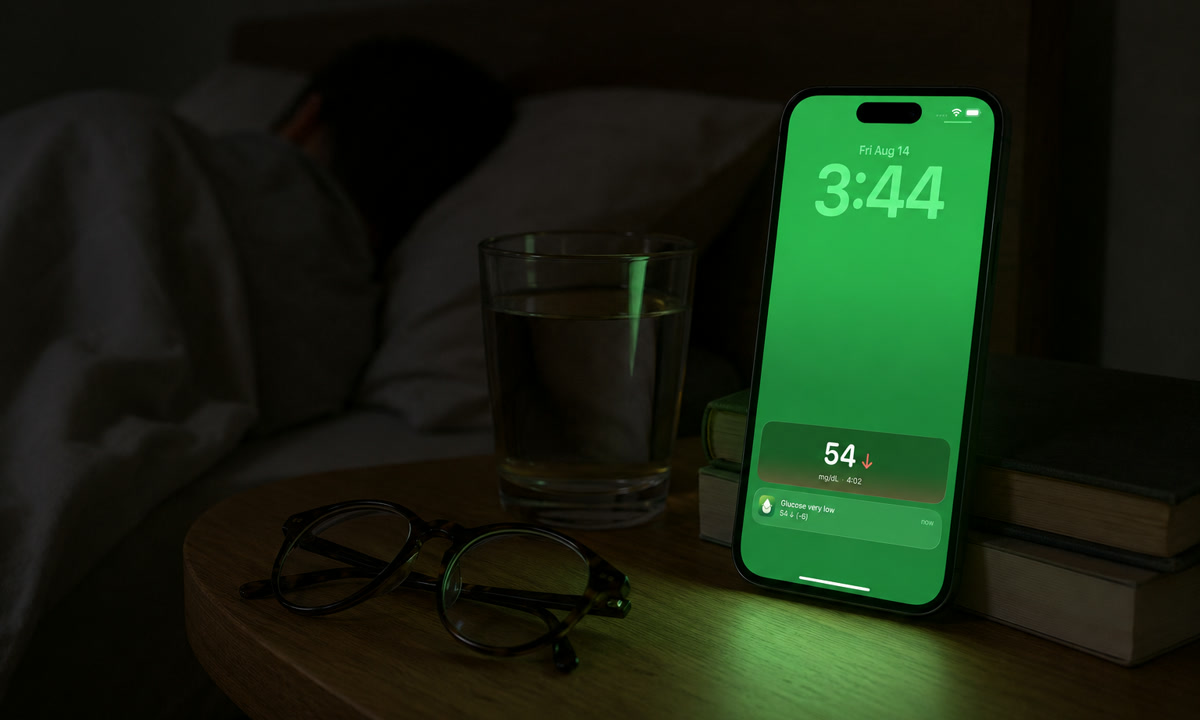
A continuous glucose monitor reads interstitial glucose every one to five minutes and can make noise before any symptom arrives. Once you are asleep, that is the whole point. NIDDK describes alarms that sound when glucose goes too low or too high as one of the main advantages of CGM over fingersticks alone.
There are two different kinds of low alert, and the difference shows up most clearly at night:
- A threshold alert fires when you are already below a level you set, for example 70 mg/dL. Useful, but it starts the clock after the low has begun.
- A predictive alert fires while you are still in range, based on how fast you are falling. Dexcom’s Urgent Low Soon alert, for instance, warns when the system projects 55 mg/dL within 20 minutes. Sugar Sense adds a similar heading-low warning built on your recent rate of change, which buys minutes back for a treatment that works slowly at 3 a.m.
Alerts only help if they reach you. That is where most night failures live. Check a few things before you trust the setup:
- Volume up, and low alerts allowed to break through Do Not Disturb and sleep focus modes
- Phone within Bluetooth range, not in a different room behind a closed door
- Phone on a hard surface rather than face down in soft bedding, which muffles the speaker
- Sensor not pinned under your body weight all night, a common source of false low readings known as compression lows
- Battery plan: a phone that dies at 2 a.m. is a silent phone
The wider case for turning these on, and for resisting the urge to silence them after a noisy week, is covered in why real-time glucose alerts matter. Alarm fatigue is real. The fix is usually better thresholds, not fewer alarms.
Can family followers act as a second layer at night?
Yes, and it is the most reliable backup there is, because a follower’s phone sits in a different room with a different sleeper. LibreLinkUp, Dexcom Follow, Nightscout and Sugar Sense Care Circle all send low alerts to someone else’s device while you sleep.
A second layer works when the plan is boring and specific. Decide in advance which number triggers a text and which triggers a phone call. Decide who calls, so two people do not both wait for the other. Agree on what happens if there is no answer, whether that is a second call, a house key or a knock on the door. And agree on what the follower does not do, because a well-meaning 4 a.m. text about a reading of 95 mg/dL trains everyone to ignore the next one.
Parents of young children run this pattern nightly, and it works. If you are the person watching rather than the person wearing the sensor, the practical side of following someone remotely is in our caregiver’s guide to remote glucose monitoring. One caution, though. Follower apps depend on a phone, an internet connection and a cloud service, so treat them as a second layer rather than the primary alarm.
How to lower the risk of a low blood sugar at night
None of this is treatment advice; it is the part of the night that is yours to set up. Look at the bedtime number together with its trend arrow, because 110 and falling is a different night from 110 and flat. Keep the low and urgent-low alerts on and loud, and add a predictive one. Give one person follower access and the boring plan above. Note the nights that followed exercise, alcohol or a small dinner, so the pattern is visible to your care team instead of only to you. And ask that team, not a blog, whether a bedtime snack makes sense for you and what it should be.
If a night alert wakes you and a check confirms a low, NIDDK’s guidance for a reading under 70 mg/dL is to eat or drink 15 to 20 grams of glucose or carbohydrates right away, then re-check, and its examples include four glucose tablets or half a cup of fruit juice. Keep whatever your team recommends within reach of the bed, not in the kitchen.
What to review with your care team if night lows keep repeating
A repeating overnight low is data, and it belongs in front of your clinician rather than in a private cycle of trial and error. Bring the actual overnight traces from the last two to four weeks, not a summary from memory.
Things worth walking through together:
- Timing. Do lows cluster at the same hour, for example just after midnight or between 3 and 5 a.m.? A consistent hour points to a pattern your team can work with.
- Triggers. Note nights that followed exercise, alcohol, a late or unusually light dinner, illness, or a change in routine.
- Your medication plan. Any change to medication timing or amounts is a conversation for your prescriber, and only your prescriber.
- Awareness. Tell them honestly if you no longer feel lows coming. That answer often changes the whole plan.
- Alert settings. Ask whether your low threshold and predictive settings suit your nights, and whether a different level makes sense while you sleep.
- Emergency readiness. Ask about a glucagon prescription and make sure the people you live with know where it is kept and how it is used.
- Time below range. Review the percentage of readings under 70 and under 54 mg/dL against the consensus targets above, and track whether changes move those numbers.
Sensor placement belongs on that list too. If lows appear only on the side you sleep on and recover the moment you roll over, that is the signature of pressure on the sensor rather than a true low. Moving the next sensor to a different site often ends the pattern.
Frequently asked questions
Can nocturnal hypoglycemia happen with no symptoms at all?
It can, and that is the main reason night lows get underestimated. Sleep weakens the hormone response that normally produces sweating and a racing heart, and repeated lows weaken it further, so glucose can dip and recover without waking anyone in the house. The education project cited above puts the share of symptom-free night lows as high as 80 percent.
Will a CGM alarm actually wake me up?
Sound level, phone placement, sleep focus settings and how deeply you sleep all decide that. Usually the alarm wins. Not always, and not for everyone. Anyone who has slept through one should treat that as information: set a predictive warning that fires earlier, and add a family follower as a second layer.
Why does blood sugar drop at 3 a.m.?
Because 3 a.m. sits at the start of the late sleep phase, when the hormones that push glucose back up are at their quietest and the last meal is furthest away. Add yesterday’s exercise, an evening drink or a small dinner, and the line has nothing holding it up.
What is a dangerously low blood sugar while sleeping?
Below 70 mg/dL (3.9 mmol/L) is a low. Below 54 mg/dL (3.0 mmol/L) is the level the Time in Range consensus calls clinically significant, the range where thinking and self-rescue start to fail, and the consensus target is less than 1 percent of the day there.
Can you have nocturnal hypoglycemia without diabetes?
It is uncommon, and it happens: heavy evening drinking, some medicines, and reactive lows a few hours after a large meal can all pull glucose down overnight in someone without diabetes. Repeated night symptoms without a diagnosis are a reason to see a clinician, not a reason to buy a sensor.
Does a high morning reading mean I was low overnight?
A morning rise can come from the dawn phenomenon, hormones alone, with no low anywhere in the night. So no, the number by itself proves nothing. Scroll back through the overnight CGM graph instead of guessing, because the two situations call for very different conversations with your team.
Where Sugar Sense fits into the night
Sugar Sense was built around exactly this problem: a second, independent layer of alerts on top of your sensor’s own app, including a heading-low warning that speaks while you are still in range, plus Care Circle so someone else’s phone rings when yours does not. If nights are your weak spot, start with the alert setup and leave the rest for later.
This article is general education, not personal medical guidance. Sugar Sense is a companion app: it displays and forwards data from your CGM, and it does not replace your sensor, its own alarms or a fingerstick check when symptoms and readings disagree. Decisions about treatment, medication and alert levels belong to you and your healthcare team. Our full disclaimer spells out the limits.