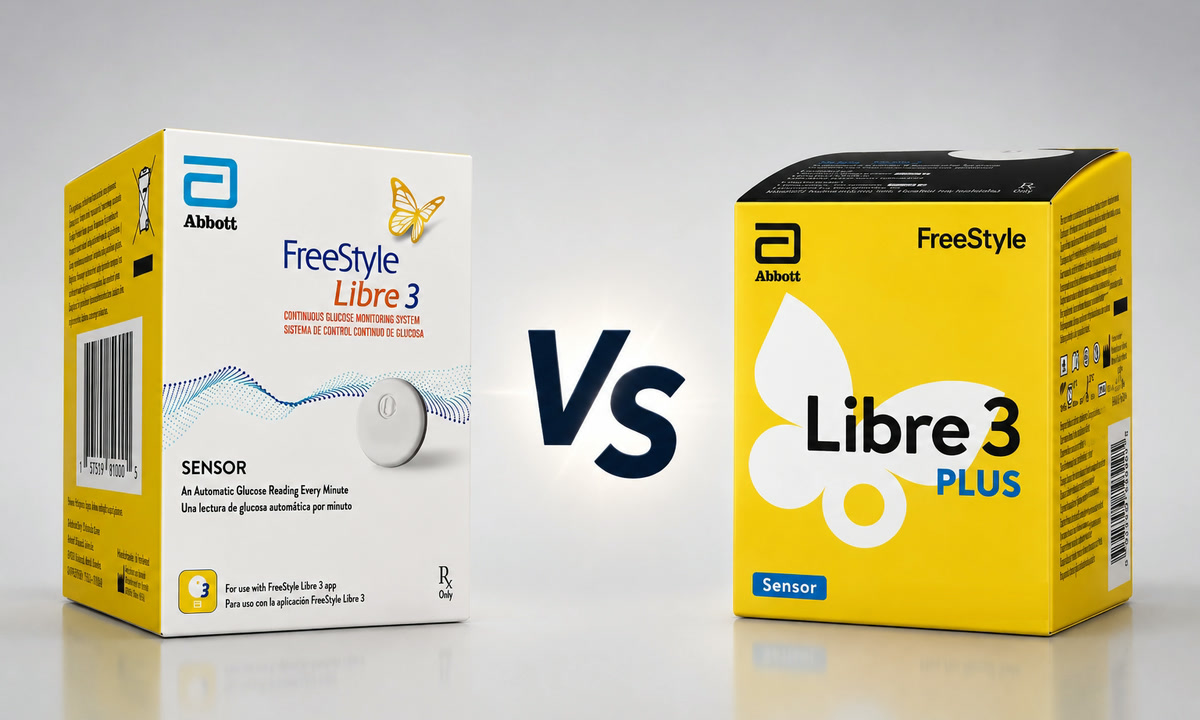
Your pharmacy refill shows up and the box says Libre 3 Plus, not Libre 3. Same white box, same tiny sensor inside. One extra word on the label, and if you use a CGM, follow someone who does, or help patients choose between sensors, that label changes a few practical things that are worth knowing before you start the next one.
The short version of FreeStyle Libre 3 vs Libre 3 Plus: Libre 3 Plus is a revision of Libre 3, not a completely different system. Abbott extended the labeled wear period from 14 days to 15, lowered the approved age to 2 years and older, and built Libre 3 Plus for use with compatible automated insulin delivery pumps. Same app, same size, same one minute readings.
This comparison is for current FreeStyle Libre users, caregivers, and clinicians who are deciding whether Libre 3 Plus is actually better, whether the switch changes daily use, and what to expect around pump compatibility, accuracy, app support, and setup. It also covers the practical handoff from Libre 3 to Libre 3 Plus, including how to avoid confusion about connectivity and how third-party apps such as Sugar Sense fit into the changeover.
What changed, in one glance:
- Wear period: 14 days on Libre 3, 15 days on Libre 3 Plus, per Abbott’s labeling.
- Approved ages: Libre 3 Plus is cleared for people 2 years and older.
- Pump integration: Libre 3 Plus is the sensor Abbott built for automated insulin delivery partners.
- App: both run on the FreeStyle Libre 3 app, and followers still use LibreLinkUp.
- Hardware feel: same coin-sized sensor, same one hour warm-up, same applicator.
On this page
What actually changed between Libre 3 and Libre 3 Plus
Libre 3 Plus is a 15 day sensor cleared for ages 2 and up. It keeps the Libre 3 form factor and adds compatibility with connected insulin pump systems. Everything you touch daily carries over: both models have similar physical sizes, the applicator and app screens feel the same, and readings arrive automatically every minute without scanning.
Start with the wear period, because that is the change people notice first. Libre 3 is labeled for up to 14 days. Libre 3 Plus, up to 15. That single day is the whole difference in wear, and Abbott states it plainly on its FreeStyle Libre 3 Plus product page.
The age indication moved too. In the United States, Libre 3 was cleared for people 4 years and older; Libre 3 Plus took that down to 2. For families with a toddler on a sensor, that is not a footnote. It is the reason the product exists in their house at all.
The third change matters most in the long run and least on day one. Libre 3 Plus is the Abbott sensor designed to feed compatible automated insulin delivery systems. If your pump and its manufacturer support Libre integration, the 3 Plus is the sensor on that list. Injections, or a pump without integration? Then nothing about your day changes.
What did not change: the sensor is still about the size of two stacked coins, still worn on the back of the upper arm, still warms up for 60 minutes, still sends a reading every minute to your phone, and still needs no fingerstick calibration. Glucose alarms look the same, with the same low and high thresholds you choose yourself.
| FreeStyle Libre 3 | FreeStyle Libre 3 Plus | |
|---|---|---|
| Labeled wear period | Up to 14 days | Up to 15 days |
| Approved ages (United States) | 4 years and older | 2 years and older |
| Automated insulin delivery pumps | Not the sensor built for pump integration | Built for compatible automated insulin delivery pumps |
| Phone app | FreeStyle Libre 3 app | FreeStyle Libre 3 app, current version required |
| Warm-up | 60 minutes | 60 minutes |
| Readings | Every minute, no scanning | Every minute, no scanning |
| Published accuracy (MARD) | About 8 percent | About 8 percent |
Do Libre 3 and Libre 3 Plus use the same app?
Yes, both run in the FreeStyle Libre 3 app on a compatible smartphone, though Libre 3 Plus requires a current version of it. Scan a 3 Plus with an out of date app and it will tell you to update before it starts the sensor.
That shared app is why the switch feels like nothing. Your alarms carry over. Notes, logbook history and reports stay in the same account. Glucose data still flows to LibreView for you and your clinic, and your followers still see you in LibreLinkUp with no new invitation to send.
Check one thing before you assume. Handheld readers and pump displays have their own compatibility lists, and those lists are maintained by Abbott and by each pump manufacturer, not by rumor on a forum. If you read your sensor with anything other than the phone app, look it up on Abbott’s compatibility page for your country before your last Libre 3 runs out.
Third-party apps that read Libre data through the LibreLinkUp connection, ours included, do not care which of the two sensors you are wearing. The connection is to your Libre account, not to a specific sensor model. If sharing is part of your setup, our guide on sharing Libre readings with family walks through how glucose readings move through that LibreLinkUp chain.
One extra day, and what it adds up to
Fifteen days instead of 14 means about two fewer sensor changes per year and nearly four extra weeks of wear from the same box count. Small, but real.
Here is the arithmetic. Twenty-six Libre 3 sensors at 14 days each cover 364 days, essentially a full year. The same 26 sensors at 15 days each cover 390 days. That is 26 extra days of wear, which works out to about two fewer applications across a year, two fewer warm-up hours, two fewer sites to rotate through.
There is a scheduling side effect nobody warns you about. A 14 day sensor always ends on the same weekday, so your change day is fixed forever: Sunday morning, every other Sunday. A 15 day sensor shifts one day forward each time. Change on Sunday, and the next one ends Monday, then Tuesday. Within two months your change is landing in the middle of a workday. If you like a fixed change day, put the end time in your calendar the moment you apply a sensor, because your body will not learn the rhythm the way it did with 14 days.
One personal note on wear length, since people ask me. I run every sensor to the end of its official wear period and I stopped using adhesive overpatches a while back, because I stopped needing them. Sensors still come off early sometimes: I caught one on a door frame, and one of my kids pulled one off. That is life, not a product flaw, and it is the same on either version.
Is Libre 3 being phased out?
Abbott has positioned Libre 3 Plus as the successor to Libre 3 and has been converting supply to it, starting in the United States. Abbott has not published a single worldwide shutoff date I can point you to, so what you actually receive depends on your country, your pharmacy and your supplier’s remaining stock.
In practice, most people do not choose between the two. You order a refill, and one day the box says Plus. No migration to perform, no account to move.
A few honest points about the transition:
- Libre 3 sensors you already have are fine to use through their labeled wear period. Nothing switches off because a newer model exists.
- Prescriptions may need updating to name the new sensor specifically as FreeStyle Libre 3 Plus. Pharmacies usually handle this, but a mismatch between the prescription and the box is a common cause of a delayed refill, so ask early.
- Coverage is decided per product code, so a plan that covered Libre 3 may need a fresh approval or prior authorization for the Plus; your pharmacist can check before the refill.
- If you rely on a specific reader or pump, verify compatibility first. Do not let your last Libre 3 run out before you know.
In the United States, Medicare generally covers FreeStyle Libre sensors under Part B as durable medical equipment, but what you actually pay depends on your plan.
The safest sources for availability in your area are Abbott customer care and your pharmacist. Both know what is actually on the shelf, which no article can tell you.
Switching without surprises
The changeover takes one sensor cycle and no setup work. Update the FreeStyle Libre 3 app, apply the new sensor, wait out the 60 minute warm-up. Everything else stays where it was.
A short checklist for the first 3 Plus you wear:
- Update the app before you open the box, so a scan does not stall on a version prompt.
- Note the end date. It is 15 days out now, not 14.
- Confirm your glucose alarms are still on and set where you want them. App updates rarely reset these, but a 30 second check is cheap.
- If someone follows you, open the app once with data flowing and confirm they see the new sensor’s readings.
If readings stop reaching a follower after a change, it is usually the sharing chain rather than the sensor. Our notes on fixing stale LibreLinkUp data cover the usual causes, and the broader Libre troubleshooting guide covers sensor errors and adhesive problems.
Accuracy is the other question people bring to a switch. Abbott publishes overall MARD figures in the same range for both sensors, around 8 percent, and neither requires fingerstick calibration. High doses of Vitamin C can affect sensor accuracy in both models. Continuous glucose monitors measure fluid under the skin rather than blood, which is why a meter and a sensor can disagree by a bit at any moment, as the NIDDK explains in its CGM overview. That physics is identical on both models.
Your data should stay flat. If your Time in Range sat at 72 percent inside the standard 70 to 180 mg/dL (3.9 to 10.0 mmol/L) target used by the 2019 International Consensus on Time in Range, it should sit near 72 percent after the switch too. A big jump in either direction after a sensor change usually says something about that individual sensor or its site, not about the model.
Frequently asked questions
Can I use Libre 3 Plus with the FreeStyle Libre 3 app?
Both sensors work with the FreeStyle Libre 3 app on a compatible smartphone, yes, though Libre 3 Plus needs a reasonably current version of it. Update the Libre app before applying your first 3 Plus so the sensor start is not interrupted by a version prompt.
Is Libre 3 Plus more accurate than Libre 3?
Abbott reports overall accuracy in the same range for both, roughly 8 percent MARD, and both are cleared for treatment decisions based on their readings without fingerstick calibration. If readings do not match symptoms, confirm with blood glucose monitoring, especially around low glucose concerns. Treat 3 Plus as a wear period and compatibility update, not an accuracy upgrade you will notice day to day.
Can I still use leftover Libre 3 sensors?
Unopened Libre 3 sensors stay usable until their printed expiration date and run their normal 14 day wear. A newer model on the market does not disable older stock. Just remember the change day math shifts once you start on 15 day sensors.
Does family sharing work the same on Libre 3 Plus?
Sharing runs through your Libre account, so followers in LibreLinkUp keep seeing your current glucose and trend arrows through the same account-based sharing flow with no new invitation. If data goes stale, check the phone running the sensor first, not the follower’s app.
How Sugar Sense fits into the switch
Because the connection is to your Libre account rather than to a sensor model, Sugar Sense keeps showing your glucose and firing your high and low alerts straight through a Libre 3 to Libre 3 Plus changeover, on your iPhone and on your wrist. Nothing to reconnect, nothing to re-invite. The only thing to update is the end date in your head, from 14 days to 15.
This article is general education about Abbott’s sensors, not medical advice, and it does not replace the product labeling that ships with your sensor. A companion app like ours shows the data your CGM sends and adds a second layer of alerts, but it is not a medical device and never replaces your sensor’s own app or alarms. For device selection, data interpretation, and treatment decisions, talk to your healthcare provider. FreeStyle Libre, Libre 3 and Libre 3 Plus are trademarks of Abbott; Sugar Sense is an independent companion app and is not affiliated with, endorsed by or sponsored by Abbott. Our full disclaimer page spells out the rest.