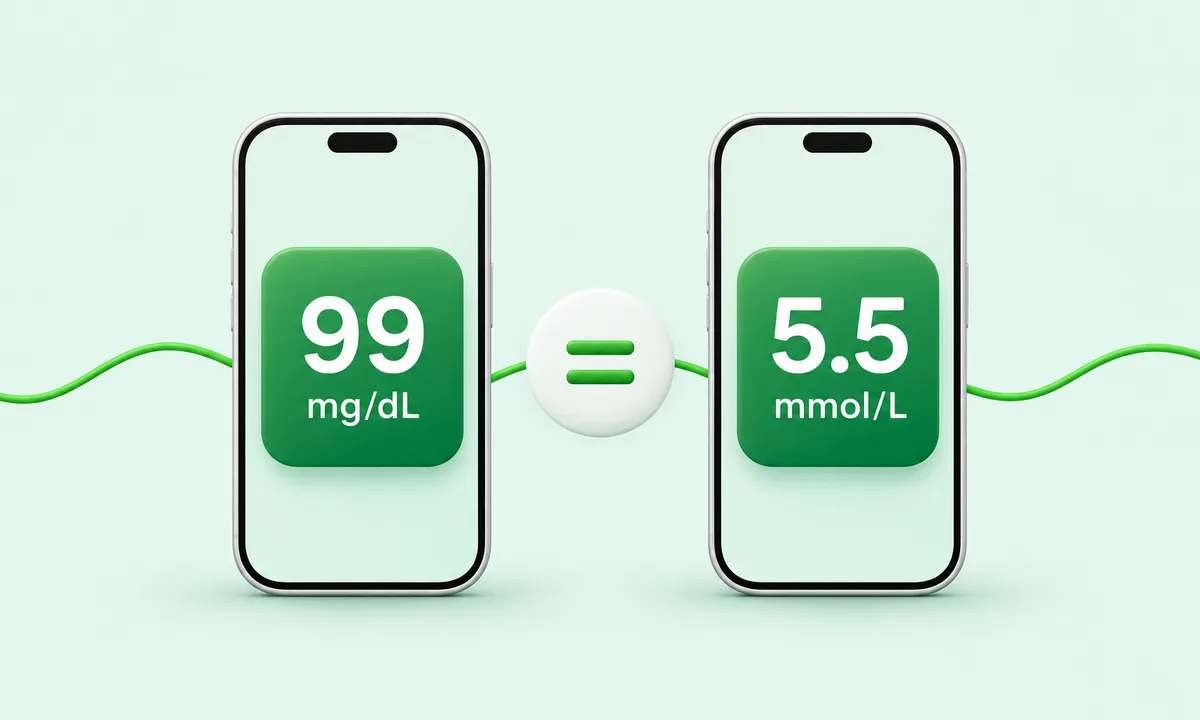
To convert mmol/L to mg/dL, multiply by 18. To go back, divide by 18. So 5.5 mmol/L is about 99 mg/dL, and 126 mg/dL is about 7.0 mmol/L. Same blood, same glucose, two different scales.
If you wear a CGM, follow someone’s glucose in an app, or compare a lab report with a meter bought in another country, you will meet both scales sooner or later, and mixing them up causes confusion at exactly the wrong moment.
The exact factor is 18.016, because glucose weighs 180.16 grams per mole. Rounding to 18 throws you off by well under 1 mg/dL anywhere near the normal range, so the mental math holds up fine when you are reading a chart or a forum post.
One number, two scales: mg/dL counts the weight of glucose in a tenth of a liter of blood, while mmol/L counts how many glucose molecules are in a full liter. Multiply mmol/L by 18 for mg/dL, divide mg/dL by 18 for mmol/L, and nothing about your actual glucose changes.
On this page
mmol/L vs mg/dL: why two blood sugar units exist
mg/dL is a mass measurement. mmol/L is a molecular count. Medicine split over which one to standardize on in the second half of the twentieth century: countries that moved their lab reporting to SI units adopted millimoles per liter, and countries that kept the older mass-based reporting stayed with milligrams per deciliter.
Roughly speaking, mg/dL is the everyday scale in the United States, Japan, India, much of Latin America and parts of continental Europe, including France, Italy and Spain. mmol/L is standard in the United Kingdom, Ireland, Canada, Australia, New Zealand, China, the Netherlands and the Nordic countries. Germany uses both, depending on the region, the clinic or the meter.
Neither one is more accurate. But the confusion is real, and it has a safety edge: someone used to mg/dL who sees 5.0 on a screen might read it as terrifyingly low when it is an ordinary 90 mg/dL. That is one reason diabetes education materials and international guidelines now print both scales side by side.
How to convert mmol/L to mg/dL (and back) in your head
The fastest trick for mmol/L to mg/dL is to multiply by 20, then subtract double the original number. For 6.5 mmol/L: 6.5 times 20 is 130, minus 13, which gives 117 mg/dL. The true answer is 117.1.
For mg/dL to mmol/L, divide by 2 and then by 9. For 200 mg/dL: half is 100, and 100 divided by 9 is 11.1 mmol/L. Correct to the decimal.
Memorizing four anchor values beats doing arithmetic at all, because each of these converts cleanly:
- 3.0 mmol/L = 54 mg/dL, the threshold for clinically significant low glucose
- 4.0 mmol/L = 72 mg/dL, just above the usual low cutoff
- 5.0 mmol/L = 90 mg/dL, a common fasting number
- 10.0 mmol/L = 180 mg/dL, the top of the standard target range
Once 10 and 180 are locked in, most conversions become an adjustment rather than a calculation. And if you want the decimal handled for you, our blood sugar converter does both directions instantly, including the awkward values in between.

Common blood sugar values in both units
The table below covers the values that actually show up in clinic letters, CGM reports and diabetes forums, with the meaning each one usually carries in guidelines. Thresholds like 70 mg/dL (3.9 mmol/L) and 54 mg/dL (3.0 mmol/L) come from the international consensus on CGM reporting, and the American Diabetes Association uses the same two cutoffs for level 1 and level 2 low glucose. The fasting and two-hour rows follow the ADA’s diagnosis cut-offs.
| mmol/L | mg/dL | Commonly described as |
|---|---|---|
| 2.2 | 40 | Lowest number most CGMs display (LO or LOW below it) |
| 3.0 | 54 | Clinically significant low (level 2) |
| 3.9 | 70 | Standard low threshold (level 1) |
| 4.4 | 80 | Low end of the ADA before-meal target |
| 5.0 | 90 | Typical fasting value |
| 5.6 | 100 | Fasting value where the ADA prediabetes range starts |
| 6.7 | 120 | Comfortable post-meal number |
| 7.0 | 126 | ADA fasting cutoff for a diabetes diagnosis |
| 7.8 | 140 | Two-hour tolerance test cutoff (normal is below it) |
| 10.0 | 180 | Top of the standard target range |
| 11.1 | 200 | Two-hour tolerance test cutoff for a diabetes diagnosis |
| 13.9 | 250 | Threshold for level 2 high glucose |
| 16.7 | 300 | Well above range |
| 22.2 | 400 | Highest number many CGMs display (HI or HIGH above it) |
One habit worth building: whenever you write a number down for a doctor, a school nurse or a family member abroad, write the scale next to it. “7.8” means nothing on its own. “7.8 mmol/L” means everything.
What does a 70 to 180 mg/dL target look like in mmol/L?
The standard target range of 70 to 180 mg/dL is written as 3.9 to 10.0 mmol/L. The goal published in the 2019 international consensus is spending more than 70 percent of the day inside it, with under 4 percent below 70 mg/dL and under 1 percent below 54 mg/dL (Battelino et al., 2019).
Put that on a real day. Someone wakes at 108 mg/dL (6.0 mmol/L), peaks at 165 mg/dL (9.2 mmol/L) after breakfast, drifts to 92 mg/dL (5.1 mmol/L) before lunch, dips to 68 mg/dL (3.8 mmol/L) during an afternoon walk, climbs to 210 mg/dL (11.7 mmol/L) after a pasta dinner, settles back to 140 mg/dL (7.8 mmol/L) by bedtime, and stays near 105 mg/dL (5.8 mmol/L) overnight.
Only two moments in that day sit outside 3.9 to 10.0 mmol/L. And 70 percent of 24 hours works out to 16 hours and 48 minutes inside range. To see how those percentages translate into hours and minutes, our guide to Time in Range walks through the arithmetic.
Can you switch the unit in your CGM app?
In most manufacturer CGM apps the display scale follows the country the app and the account were set up for, and there is usually no switch you can flip later. Dexcom even published its G6 app in Germany, where both scales are in use, as two separate apps, one per scale. That is why someone who moves abroad and sets up a new sensor or meter there can end up reading a scale they never used before.
What you can usually do:
- Self-hosted Nightscout: set the DISPLAY_UNITS variable to mg/dl or mmol in your site’s configuration, then restart the site. The official Nightscout documentation lists it among the required variables and adds one warning: make sure it matches your uploader and your followers. If the site stops answering afterwards, our Nightscout troubleshooting guide covers the usual connection fixes.
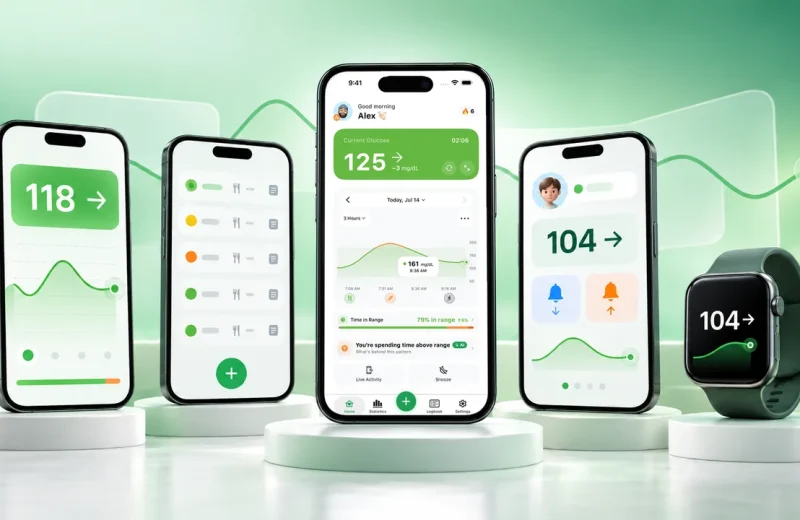
- Follower and companion apps: many, including ours, expose a plain unit picker so a parent in Toronto can read mmol/L while the sensor app on the kid’s phone in Michigan shows mg/dL.
- Meters and readers: most current models are set at the factory to the scale of the country they are sold in and cannot be switched in the menu, so check which scale a meter shows before you trust one bought abroad.
If your app has no picker and you need the other scale, print the conversion chart from our converter page for the fridge, or bookmark the converter itself. The middle of a low is not the moment for arithmetic.
Frequently asked questions
What does mg/dL mean?
mg/dL stands for milligrams per deciliter: the weight of glucose in one tenth of a liter of blood. A reading of 100 mg/dL means 100 milligrams of glucose in each deciliter. It is the everyday scale in the United States.
What does mmol/L mean?
mmol/L stands for millimoles per liter. A mole is a chemist’s counting unit, so this scale counts glucose molecules in a liter of blood instead of weighing them. One millimole of glucose weighs 180.16 milligrams, which is where the factor of 18 comes from.
Is 18 or 18.016 the correct conversion factor?
The precise factor is 18.016, derived from glucose’s molar mass of 180.16 g/mol. Plain 18 shifts a result by roughly 0.1 percent, which is about 0.2 mg/dL at a reading of 180. Labs use the exact figure. For everyday reading, 18 is plenty.
Why does an A1C result not need converting?
Because A1C is reported as a percentage or in mmol/mol, and it measures glycated hemoglobin rather than glucose concentration, so the 18 factor does not apply. Estimated average glucose derived from A1C is a different story: it is printed in mg/dL or mmol/L and follows the same rule, and our A1C calculator shows it in both.
Which scale should I use when talking to my care team?
Whichever one your clinic charts in, since that is the scale on your lab reports and in their target discussions. If you also follow international communities, learn the handful of anchor values in the other scale so screenshots and forum advice stop feeling like a foreign language.
Reading one scale while your sensor speaks another
Mixed-scale households are common, and a companion app should not force everyone onto the same reading. Sugar Sense lets each person pick mg/dL or mmol/L for their own phone and watch, so the same live sensor data reads naturally whether it lands in London or Los Angeles.
This article is general education about measurement scales, not medical advice, and no companion app replaces your CGM, its own alarms or a fingerstick check when something feels off. Targets, thresholds and any treatment change belong to a conversation with your healthcare team; the full terms of what we can and cannot tell you are worth a read.